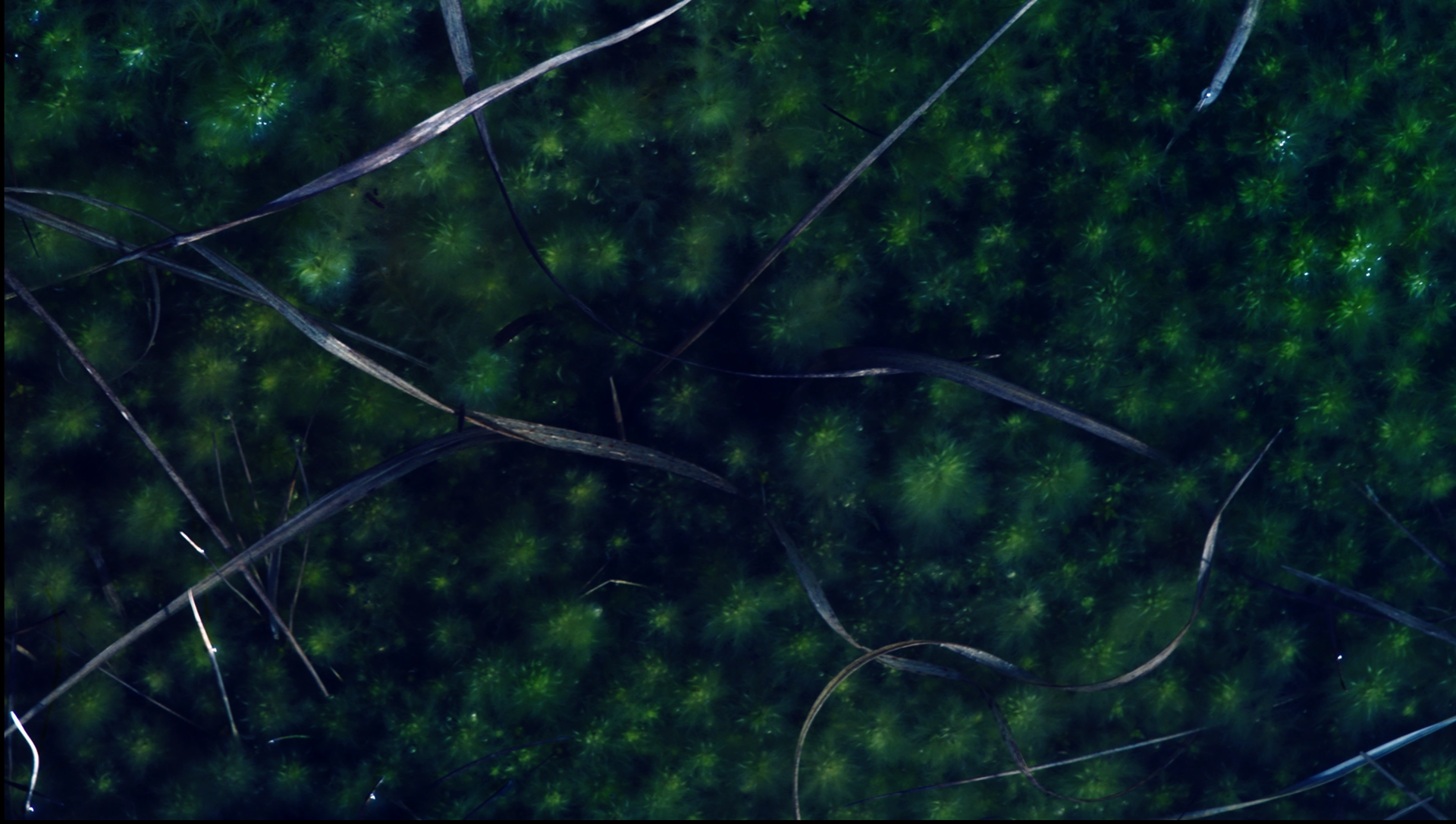
This Is Not Moss is an audiovisual composition that invites audiences to imagine mosses, liverworts, and lichens as vibrant, dynamic, and restorative forms of life. Rather than presenting these organisms as passive elements of the landscape, the work foregrounds their agency and ecological relationships through the interaction of edited field recordings, moving images, and a score-based performance for Gendèr Barung by Rob Campion.
Inspired by Jane Bennett's theory of vibrant matter, the composition challenges anthropocentric ways of perceiving nature by treating nonhuman organisms as active participants rather than passive objects. Drawing on Bennett, Spinoza, and Deleuze and Guattari, the work explores how ecological meaning emerges through relationships between bodies, sounds, and environments. Rather than functioning as accompaniment, the field recordings represent the species as active participants whose behaviours intersect with those of the recorded performer, whose music represents the wind, water, insects, and the surrounding sonic environment of the bio-community. The resulting musical texture becomes a sonic ecology in which mosses, weather, insects, recorded performer, instrument, loudspeakers, microphones, and computer technologies coexist as interacting agencies. The composition therefore does not depict nature from an external human perspective but attempts to evoke a world animated by multiple forms of material agency that exist independently of human intention.
The audiovisual materials document Sphagnum capillifolium, Pleurozia purpurea, Cladonia portentosa, and Sphagnum cuspidatum recorded on the Isle of Hoy, Orkney. Close-up video and microphone recordings reveal the organisms' textures and sonic qualities—crunching, squelching, dryness, and moisture—highlighting forms of vitality that often escape human attention. The resonant timbre of the Gendèr Barung, performed in the sléndro tuning system, evokes the cool luminosity of mosses and lichens, while repeated, stretched, and fragmented musical gestures mirror bryophytes' reproduction through fragmentation.
The title references Magritte's The Treachery of Images, reminding audiences that recordings and images are representations rather than the organisms themselves. Acknowledging the mediation inherent in audiovisual art, This Is Not Moss reflects on both the possibilities and limitations of representing nonhuman worlds while encouraging renewed attention to their ecological vitality and agency.